A weighty success story from the lab
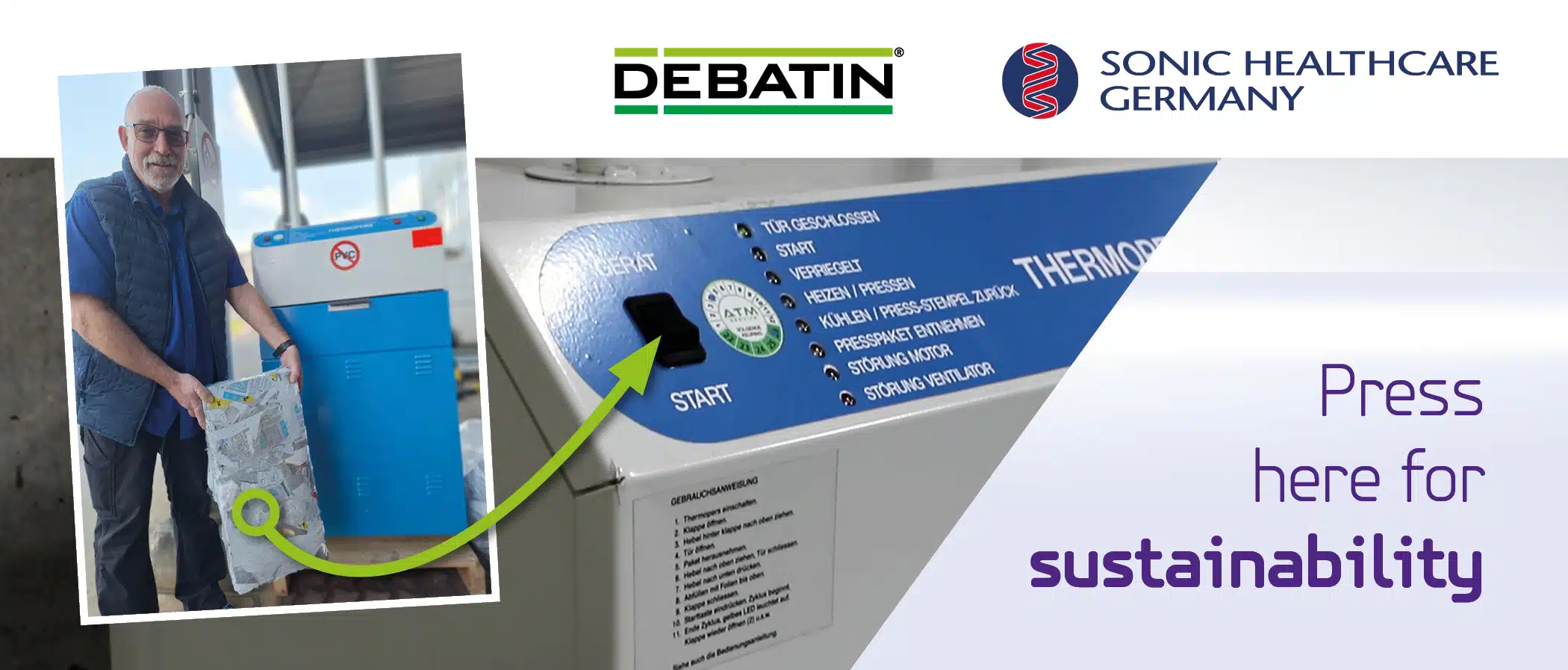
We all know these days that cleanly separating materials is the key to being able to recycle plastics effectively. However, making that happen depends on ideas, drive and customer focus. Those were exactly the ingredients of our success story in the pre-analytics domain, arising from a collaboration between DEBATIN and Sonic Healthcare Germany.
Headquartered in Australia, the Sonic Healthcare group is one of the leading providers of medical diagnostic services worldwide. These services rely on laboratory logistics, which in turn must follow stringent safety and hygiene regulations. Sonic Healthcare Germany numbers among DEBATIN’s customers, and is now using one of DEBATIN’s most recent solutions to manage a reliable, professional recycling process at seven of its sites. Ultimately, it’s all about plastic! The solution is a baler that compacts used lab transport bags. DEBATIN provides these balers for its customers. “The compacted bales are collected regularly by a logistics company we use, and returned straight into the recycling loop,” explains Jörg Keilbach, DEBATIN’s Process Manager and Sustainability Officer.
Sustainability in the lab is important to everyone
It’s not just the teams in the Sonic Healthcare Germany labs – in Munich (Staber lab), Limburg (Biovis), the Bremen and Hamburg medical labs and the Bioscientia labs in Ingelheim, Giessen and Karlsruhe – who are convinced the company is on the right track. Regina Karakina, Sustainability Manager at Sonic Healthcare Germany, tells us that her international counterparts have also expressed interest in this key stage in the recycling process. “Labs urgently need to be paying more attention to sustainability,” she explains, “and most of the people who work in them are fully aware of this – in fact, it’s often one of their core values.” Sonic Healthcare Germany has already taken a positive step in this direction, as it uses DEBASAFE® medical lab bags, in various sizes – which are all made of post-consumer recycled material. The lab teams see it as a logical step to use the thermal balers to guarantee properly sorted waste for the next stage of the recycling process– and as the right way to improve sustainability.
A short briefing – and the pressure is on
It wasn’t too challenging to get the technology established in the labs, says Regina Karakina: “The balers don’t take up much room and our staff find them easy to use.” What’s important, and what Regina can report has also been provided by DEBATIN employees at all seven Sonic Healthcare Germany locations, is a short introduction on how to use the baler: “Keeping materials separate for recycling is so important, and a briefing is essential so that we can make sure to do it right. For example, gloves mustn’t be slipped in between the lab bags – they’re made of a different material.”
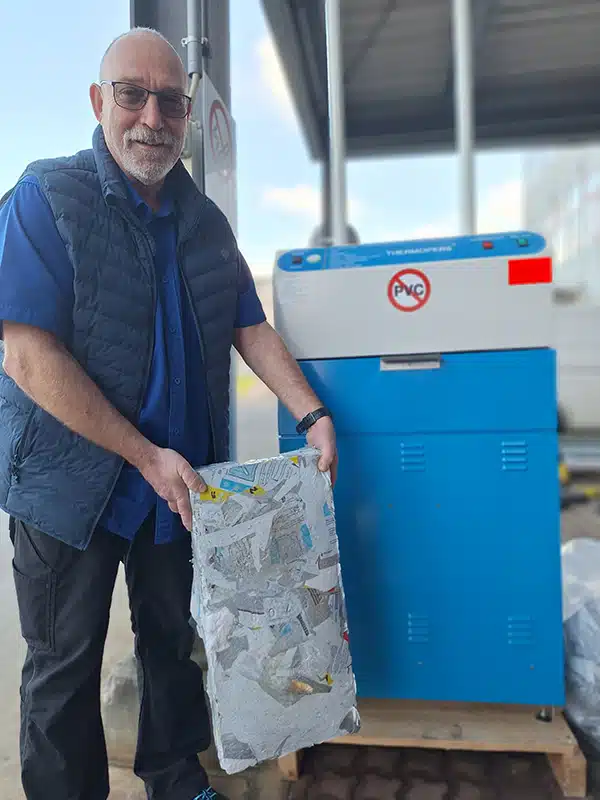
Jürgen Heß is head of Supply Chain Management at Bioscientia Healthcare GmbH and a big fan of DEBATIN’s recycling balers
As Jörg Keilbach explains, one of the balers provided by DEBATIN can compact around 1,200 lab bags into a bale. Since the process heats the material to around 200 °C at various stages, the bale can also be considered to have been sanitised as it goes on through the recycling loop. Bales weigh between five and seven kilograms and are stacked into reusable boxes supplied by DEBATIN. “We ask the customer to let us know when the boxes are full, so that we can arrange collection and make sure that the customer always has empty boxes available,” explains Jörg Keilbach. Another important point: if the transport bags were contaminated during sample transportation, they must not be fed into this recycling process – health and safety requires contaminated bags to be disposed of separately.
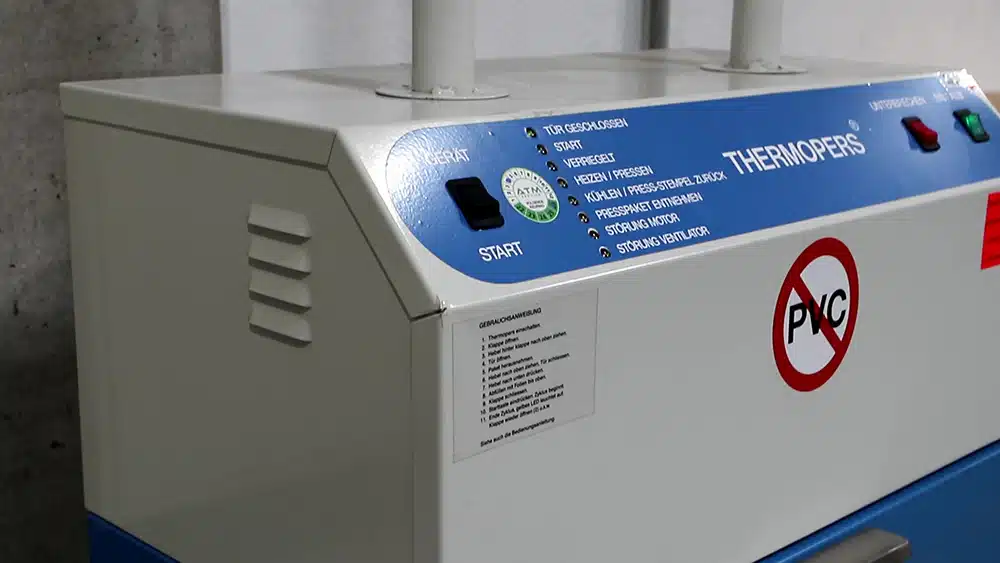
Just press the button and the plastic recycling baler provided by DEBATIN sets to work

Close-up of the DEBATIN plastic recycling baler. It sits on a Euro-pallet. A metal handle and ventilation slots are visible.
Recycling lab bags is a way to reduce Scope 3 GHG emissions
Regina Karakina has noticed that there is a trend shift underway. People are starting to focus more on sustainability in the lab. “Laboratories are part of the critical infrastructure, and sustainability isn’t automatically a priority here. However, things are changing for the better, due more to a bottom-up than a top-down effect.”
Although DEBATIN’s lab transport bags don’t yet get a mention in Sonic Healthcare Germany’s sustainability report, Regina believes that Scope 3 emissions (defined as the indirect greenhouse gas emissions associated with the company’s value chain) are becoming more important. After all, logistics have a big role to play, particularly for a corporate group like Sonic Healthcare Germany that provides lab services to medical practices – and that means their carbon emissions are equally relevant. DEBATIN CEO Frank Rieker is delighted about the collaboration: “A uniting element with mutual benefits for both our companies, and another success story for DEBATIN”.



From “large” to “compact” – the recycling baler compresses used lab bags into small volumes. The compact bales fit perfectly into reusable boxes and can be easily stacked for collection.
Solutions that no one had thought about
Sustainability manager Regina Karakina sums up the project to use DEBATIN’s recycling balers: “Sonic Healthcare Germany already has several locations that are pointing the way towards a sustainable future. We’re learning from these internal pioneers, and watching the recycling baler project closely. We want to keep improving on sustainability – we’ve even set up an internal working group on the circular economy. When solutions emerge in places that hadn’t even occurred to us, we grab at the opportunity. This was only possible because our supplier DEBATIN actively approached us.”